Opening October 10 at The New York Historical (170 Central Prk W, New York, NY 10024), The Gay Harlem Renaissance examines the Black LGBTQ+ artists, writers, and performers central to the Harlem Renaissance and everyday Black gay life in the early 20th century. Marking the centennial of The New Negro—the landmark 1925 anthology edited by Alain Locke—the exhibition traces the queer creativity, friendship circles, and mentorships that flourished in Harlem’s salons, social clubs, and thriving nightlife and that helped power the Harlem Renaissance.
As Harlem grew into the nation’s largest Black metropolis after the First World War, Black Southern and Caribbean migrants, activists, and creatives transformed the neighborhood into a nexus of political activism, creative expression, and community life. Many of Harlem’s most celebrated poets, novelists, and artists were gay or bisexual (some discreetly and others openly); and many of the preeminent blues singers performing in nightclubs and basement speakeasies were lesbian, bisexual, or transmasculine. Whether on Harlem’s biggest stages or in its nightclubs or hidden speakeasies, LGBTQ+ performers took center stage. Together they helped shape the cultural innovation that defined the era. Amid this cultural convergence, queer and straight artists formed close-knit circles—living together, mentoring one another, and exchanging ideas that shaped the future of Black art and culture. Their creative tensions—whether over how openly to depict same-sex desire or the so-called “unrespectable” venues of Harlem’s nightlife—helped shape the bold, expansive spirit of the Harlem Renaissance.
“The Gay Harlem Renaissance provides a sweeping portrait of Harlem after the First World War, when a remarkable generation of Black artists, thinkers, and performers—many of them members of the LGBTQ+ community—shaped a new cultural vanguard,” said Dr. Louise Mirrer, president and CEO of The New York Historical. “We hope that this show will invite visitors to consider how intimate friendships, chosen families, and radical ideas about identity helped define the Harlem Renaissance and continue to resonate today.”
“The Gay Harlem Renaissance shows that Black LGBTQ+ life was far more visible, accepted, and integrated into the daily life of 1920s Harlem than most people imagine,” said George Chauncey, the exhibition’s chief historian, a Columbia history professor who is the author of Gay New York, 1890-1940. “The exhibition takes visitors to the basement speakeasies, rent parties, and drag balls where ordinary queer and straight people built lives together, as well as to the salons of the cultural elite.”
Featuring more than 200 objects, The Gay Harlem Renaissance unites painting, sculpture, artifacts, documents, photographs, books, and music from collections across the country and celebrates the creativity, innovation, and resilience of Black LGBTQ+ Harlemites. Highlights of the exhibition include:
● Employment of the Negro in Agriculture, a 1934 painting by Earle Richardson, on loan from Howard University, honors the resilience of African American agricultural laborers within the oppression of the Jim Crow system.
● Color, the 1925 first edition of Countee Cullen’s first book of poetry, published when he was 22. Countee Cullen found a champion and mentor in Alain Locke, who included his poetry in The New Negro and helped Cullen accept his sexuality.
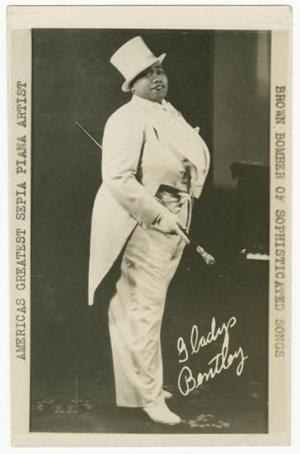
● Gelatin silver print of Gladys Bentley, circa 1927-45. Taunted as a child for her unfeminine demeanor, the transmasculine performer Gladys Bentley became a star in Harlem, singing and playing piano all night at rent parties and popular nightclubs. Her signature white tuxedo and top hat have become icons of queer self-expression on and off the stage.
● Rent party tickets. Throwing apartment parties with a small cover charge in exchange for entertainment and lively company helped working-class residents pay the rent. The fact that LGBTQ+ Harlemites could dance and flirt with people of the same sex at such parties was a powerful sign of their acceptance among Harlem’s working-class residents.
● Meditation and Music, a 1925 watercolor by Aaron Douglas. Influenced by the work of Alain Locke, Douglas moved to Harlem, where he illustrated some of the most famous books and magazines of the Harlem Renaissance. While Douglas was not gay, he was close to many Black queer artists and moved in their social circles.
● Sculptures by Richmond Barthé, whose artworks chart his movement through interracial and transatlantic gay social circles. His subjects included the popular singer and nightclub owner Jimmie Daniels and the queer Senegalese dancer François “Féral” Benga, whom he met in Paris.
● 1939 issue of The Crisis magazine. Black publications experienced tremendous growth in readership, circulation, and influence during the interwar years. The Black press provided coverage of the vibrant political, cultural, and social life in Harlem and beyond.
● Photographs by Morgan Smith and Marvin Smith created an extraordinary documentary record of the Harlem community from the 1930s to 1950s. Their work captured Black joy and struggle alike. Marvin was gay, and he came to know most of the pioneering figures of the Harlem Renaissance.
● Recordings of blues songs with queer themes by singers such as Bessie Smith, Ma Rainey, and Ethel Waters, as well as specially created audio recordings of poetry by Langston Hughes and other poets, as well as a passage from Nella Larsen’s novel, Passing.
● Recreation of the prize-winning gown worn by Bonnie Clark at the 1932 Hamilton Lodge Ball, the largest drag ball on the East Coast, which was held every February in Harlem’s Rockland Palace.
● Harlem Diner, a 1938 painting by Jacob Lawrence, depicting five Black figures with downturned expressions gathered in a Harlem diner, facing the struggles of daily life. During the Great Depression, Harlemites faced mass unemployment, overcrowding, and persistent racial discrimination.
The exhibition is curated by Allison Robinson, associate curator of history exhibitions, and Anne Lessy, assistant curator of history exhibitions and academic engagement, with contributions from Rebecca Klassen, curator of material culture and decorative arts, and with George Chauncey, author of Gay New York and DeWitt Clinton Professor of American History at Columbia University, as chief historian.
••••• Message Center••••
Follow us on social media: Facebook • Instagram • Threads • X • Bluesky • Tiktok • Reddit
Looking for news and events beyond NYC? Finding Connecticut and Finding The Hudson Valley have the latest happenings just north of the city!
Let’s create with Victory Designs
Need help with your creative needs? Our team has 20+ years of experience with Adobe, Shopify, and WordPress, and we offer affordable graphic design and web services. Let Victory Designs assist you with bringing your ideas to life.
Share your New York City experiences on instagram #findingnewyorkcity
Save on CBD!
My name is Jillian, and I am the editor here at Finding New York City. When I came across New England Hemp Farm a few years ago, I had recently had my ankle fused. New England Hemp Farm’s Sports Relief Rub and 500 MG Full Spectrum CBD Oil have helped with everyday and weather pain.
Finding quality products that can improve your day-to-day life can be tough, but with New England Hemp Farm, getting a good night’s sleep or relieving your pain and anxiety has never been easier. Plus, using our code NYC35, you’ll save 35% on your first purchase. Let us help you find relief and savings with New England Hemp Farm.
Products we use here at Finding New York City include Sports Relief Rub • 500 MG Full Spectrum CBD Oil • Pet Drops• Pet Treats