
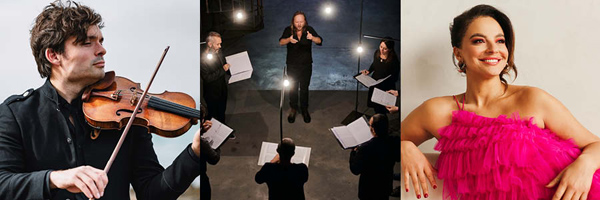
The Frick Collection has announced its 2026–27 concert season, marking the second annual series in the Stephen A. Schwarzman Auditorium since the museum’s April 2025 reopening. The program includes chamber music, vocal recitals, and early music designed to complement the museum’s permanent collection and special exhibitions.
The season opens on Sunday, October 18, with Goya’s Musical World, curated by violinist Francisco Fullana alongside the Dolphins Quartet, Viano Quartet, and guitarist Rafael Aguirre. Additional fall performances feature countertenor Anthony Roth Costanzo, early-music group Ruckus, the Isidore String Quartet with pianist Conrad Tao, and an exploration of Bach led by cellist Jay Campbell, violinist Geneva Lewis, and keyboardist Jonathan Cohen.
Two special fall concert series will connect directly to the exhibition Siena: The Art of Bronze, 1450–1500. Early-music specialists Jasper Snow, Georgia Burashko, Joshua Cheatham, and Richard Pittsinger will perform alongside Antwerp-based ensemble Graindelavoix. The museum is also introducing free pop-up afternoon performances in the Garden Court with museum admission on November 14 and November 22.
The spring 2027 lineup highlights French Renaissance enamel artist Susanne de Court through performances by early-music ensembles Twelfth Night and the Helicon Ensemble. Composer Matthew Aucoin will participate as both creator and curator, premiering a new Frick-commissioned work alongside cellist Coleman Itzkoff, while students from London’s Royal Academy of Music and period-instrument ensemble Juilliard415 perform weekday lunchtime recitals.
Additional recitalists scheduled throughout the season include mezzo-soprano Rihab Chaieb with pianist Ammiel Bushakevitz, tenor Ian Bostridge with pianist Julius Drake, cellist Jean-Guihen Queyras with pianist Alexandre Tharaud, piano duo Pavel Kolesnikov and Samson Tsoy, soloist Paul Lewis, and pianists Federico Colli and Alexandra Dovgan.
Concert tickets will be released in two phases on the museum’s website, with 2026 dates on sale September 8 following a September 1 member presale, and 2027 dates on sale December 15 following a December 8 member presale. Evening tickets are $80 and lunchtime concerts are $35, with all tickets granting museum access two hours prior to performance times.
The Frick Collection 2026-27 concert season schedule
Goya’s Musical World: Francisco Fullana, violin; Dolphins String Quartet;
Viano Quartet; Rafael Aguirre, guitar
Sunday, October 18, 5:00 p.m.
Violinist and musical curator Francisco Fullana opens the season with an inventive program that approaches artist Francisco de Goya not through painting but through sound, imagining the music that animated the painter’s world. Joined by the Dolphins Quartet, Viano Quartet, and guitarist Rafael Aguirre, Fullana explores Goya from three vantage points.
The courtly world of aristocratic patronage emerges in Boccherini’s Guitar Quintet, heard in an arrangement for full ensemble. The folk and popular traditions of Goya’s Spain—the tonadillas and zarzuelas of working-class Madrid—find a vivid parallel in one of the Frick’s Goya paintings, The Forge. The program culminates with Mauricio Sotelo’s striking contemporary work Red Inner Light Sculpture. Together, these perspectives evoke the vibrant musical life Goya cultivated in his own home, where the finest musicians of his day gathered for evenings of song and dance.
Lunchtime Concerts: Juilliard415 and Royal Academy of Music
Thursday, October 22, 1:00 p.m.
Thursday, December 17, 1:00 p.m.
Thursday, February 4, 1:00 p.m.
Thursday, March 4, 1:00 p.m.
The Frick continues its partnership with two of the world’s most celebrated conservatories—the Juilliard School and the Royal Academy of Music—with a series of weekday lunchtime concerts featuring student musicians from both institutions. Juilliard415, the school’s acclaimed period-instrument ensemble, performs three programs across the fall and winter. In the spring, musicians from London’s Royal Academy of Music offer one lunchtime performance and take part in the weekend of concerts curated by composer Matthew Aucoin.
American Harmony: Ruckus with Lily Hammond, treble; Linnea Sablosky, alto;
Tim Eriksen, tenor; John Taylor Ward, bass
Sunday, October 25, 5:00 p.m.
Rapidly becoming the Frick’s house band, the early-music ensemble Ruckus returns with American Harmony,drawn from one of the nation’s earliest repertoires: the New England hymn. In the founding decades of the republic, small Yankee towns built their own identity out of homegrown counterpoint—fervent settings of grief, mortality, and civic conscience by composers such as William Billings, Daniel Read, and their contemporaries. Featuring singers Lily Hammond, Linnea Sablosky, Tim Eriksen, and John Taylor Ward, Ruckus offers—in the year of the country’s 250th anniversary—a window into the music of a young nation.
Countertenor: Anthony Roth Costanzo & ensemble led by Dan Schlosberg
Sunday, November 1, 5:00 p.m.
Following his performances with Jupiter Ensemble to inaugurate the Frick’s Stephen A. Schwarzman Auditorium in April 2025, Anthony Roth Costanzo returns with a program tied to his latest project: Countertenor, a new book published by Farrar, Straus and Giroux and a companion recording with Nonesuch Records. Both illuminate the countertenor voice as an instrument of reinvention—part oddity, part divinity.
Costanzo brings the album to the Frick stage with an ensemble led by Dan Schlosberg. Seventeenth-century Baroque laments by Monteverdi and Dowland give way to a Mozart duet, a Hawaiian song, and avant-gardist Klaus Nomi’s “You Don’t Own Me.” Costanzo also performs a 2024 work written for him by Osvaldo Golijov, concluding with a hypnotic aria from Philip Glass’s iconic Einstein on the Beach.
Jean-Guihen Queyras, cello; Alexandre Tharaud, piano
Sunday, November 8, 5:00 p.m.
Two of France’s foremost chamber musicians return to the Frick to mark thirty years of playing together, an anniversary they distill into a single, wide-ranging program drawn from the repertoire they have recorded across three decades. The performance ranges from the Baroque viol music of Marin Marais and Francis Poulenc’s reworked Renaissance dances to the modernism of Alban Berg, with the music of Johannes Brahms anchoring both halves of the program, including the duo’s own arrangements of three Hungarian Dances.
The Music of Siena: Jasper Snow, vielle; Georgia Burashko, alto;
Joshua Cheatham, viol; Richard Pittsinger, tenor
Saturday, November 14, 2:00 p.m. (Garden Court)
Sunday, November 15, 5:00 p.m.
Fifteenth-century Siena was no silent city—its churches and streets carried chants, bells, processions, and devotional song—yet little of its notated polyphony survives, and almost none can be tied to a local composer. Led from the vielle by Jasper Snow, this program gathers pieces preserved in or near Sienese sources, several recovered from reused parchment. Works by Antonio da Cividale, Johannes Ciconia, and Zacara da Teramo set these surviving fragments within the international sound-world of the early fifteenth century—where Italian and French styles met in music of restless rhythmic and contrapuntal invention—alongside anonymous love songs and devotional works for local saints.
These performances are presented in conjunction with the Frick’s special exhibition Siena: The Art of Bronze, 1450–1500. Like the exquisite bronzes on view in the show, this music poses a question of survival: while sculpture endures as matter, music endures only through copy, loss, and dispersal—traced here from manuscript back to living sound.
The Music of Siena: Graindelavoix
Sunday, November 22, 2:00 p.m. (Garden Court)
Sunday, November 22, 5:00 p.m.
The Antwerp-based ensemble Graindelavoix, led by Björn Schmelzer and celebrated for its visceral, ornament-rich approach to early music, closes the Music of Siena series with a program that listens to the city’s golden age through the voices that filled it. These performances are presented in conjunction with the Frick’s special exhibition Siena: The Art of Bronze, 1450–1500.
In the closing decades of the fifteenth century, the legendary Franco-Flemish polyphonists who traveled south across the Alps sang in Siena’s cathedral, their music as much a part of the city’s splendor as its bronzes. At the program’s heart is Sena vetus, the only known fifteenth-century ceremonial motet in honor of Siena—the “city of the life-giving Virgin”—composed by the Franco-Flemish Arnolfo Giliardi for a Sienese patron. Around this motet unfold laments, Marian hymns, and devotional songs by Du Fay, Ockeghem, Josquin, Isaac, and Agricola—music that, like the reliefs and statues it accompanies, gives form to grief, beauty, and the sacred.
Paul Lewis, solo piano
Saturday, December 5, 5:00 p.m.
Sunday, December 6, 5:00 p.m.
Over two evenings, the British pianist Paul Lewis—celebrated for the lucidity of his Beethoven and Schubert—brings his Mozart+ project to the Frick, pairing Mozart’s sonatas with works by later composers. The Saturday concert explores Mozart through a French lens, framing Poulenc’s mercurial Improvisations and Debussy’s L’isle joyeuse with the sonatas K. 330 and K. 457. Sunday’s concert delves into the piano’s cantabile singing voice: the sonatas K. 570 and the operatic K. 333 surround Schubert’s late Drei Klavierstücke, D. 946, and a Chopin polonaise and two nocturnes. Together the recitals show Mozart’s presence surfacing in the music that came after him.
Pavel Kolesnikov & Samson Tsoy, piano four-hands
Sunday, December 13, 5:00 p.m.
Pavel Kolesnikov and Samson Tsoy have played as a duo since their student days, and their Frick debut finds them both together and alone, in a program that moves from intimacy to extremity. They share a single keyboard for Schubert’s Hungarian Divertissement and, to close, Beethoven’s four-hand arrangement of the Grosse Fuge. In between, each plays solo: Chopin nocturnes, Ustvolskaya’s explosive Sixth Sonata, and Beethoven’s late Piano Sonata in E Major, Op. 109.
Jay Campbell, cello; Geneva Lewis, violin; Jonathan Cohen, harpsichord
Sunday, January 24, 5:00 p.m.
In 1705, a twenty-year-old Johann Sebastian Bach traveled more than 250 miles on foot to study with composer and organist Dieterich Buxtehude. Avery Fisher Career Grant recipients Jay Campbell, cello (JACK Quartet), and Geneva Lewis, violin, join renowned keyboardist and conductor Jonathan Cohen for a program drawing on this monumental meeting, featuring works from both composers alongside other masters of the Baroque era.
Isidore String Quartet; Conrad Tao, piano
Sunday, January 31, 5:00 p.m.
The New York–based Isidore String Quartet makes its Frick debut with a program partly inspired by a teacher and his pupil. Frank Bridge’s Three Idylls (1906) sit beside the Three Divertimenti of Benjamin Britten, who studied with Bridge as a teenager and later built his Variations on a Theme of Frank Bridge on the second of Bridge’s Idylls. Closing the first half is Mozart’s String Quartet No. 21 in D Major, K. 575, the first of the “Prussian” quartets, composed with Prussia’s cello-playing king in mind and giving that instrument rare prominence. After intermission, star pianist Conrad Tao joins the quartet for Schumann’s Piano Quintet in E-flat Major, Op. 44, the work that established the piano quintet as a genre.
Rihab Chaieb, mezzo-soprano; Ammiel Bushakevitz, piano
Sunday, February 21, 5:00 p.m.
Mezzo-soprano Rihab Chaieb and pianist Ammiel Bushakevitz weave together two ways of hearing the Middle East and North Africa: as imagined by European composers, and as lived and sung by its own people. Alongside French art song that gazes outward—Ravel’s folk settings and the Persian and Arab evocations of Saint-Saëns, Bizet, and Aubert—they set songs from Osvaldo Golijov’s Mediterranean cycle Ayre, the Andalusian muwashshah titled Lamma Bada Yatathanna, Fairuz’s lament for Beirut, and a traditional Tunisian song from Chaieb’s own heritage. The program closes with Emel Mathlouthi’s Kelmti Horra, the anthem of the 2011 Tunisian revolution, followed by a set of traditional lullabies.
Matthew Aucoin: In Focus
Friday, March 5, 7:00 p.m.
Sunday, March 7, 5:00 p.m.
Over two evenings, composer Matthew Aucoin appears as both creator and curator. On Friday, he introduces four United Kingdom–based composers little heard in the United States—Lisa Illean, Mark Simpson, Tom Coult, and Fergus Hall. On Sunday, his own work takes center stage: his James Merrill Songs juxtaposed with Benjamin Britten’s Seven Sonnets of Michelangelo with tenor Paul Appleby, followed by Britten’s Cello Suite No. 1, Op. 72. These are paired with the world premiere of a new work by Aucoin commissioned by the Frick, written for cellist Coleman Itzkoff and performed with the composer.
Alexandra Dovgan, solo piano
Sunday, March 14, 5:00 p.m.
Nineteen-year-old Russian-born pianist Alexandra Dovgan already draws rare admiration from luminaries of the keyboard. A prodigy admitted to Moscow’s Central Music School at five and now based in Spain, she has won over audiences across Europe’s major halls with playing of unusual poise, depth, and precision. Fresh from her acclaimed United States debut in 2026, she makes her Frick debut with a program of formidable scale: Beethoven’s Hammerklavier sonata, framed by two Chopin nocturnes, Op. 27, and Rachmaninoff’s Sonata No. 2, Op. 36.
Ian Bostridge, tenor; Julius Drake, piano
Sunday, April 25, 5:00 p.m.
Ian Bostridge and Julius Drake, partners in song for some thirty years, devote an evening entirely to Robert Schumann. All three sets belong to 1840, the composer’s astonishing “year of song,” when he turned most of his creative energy to the form: the rarely heard Op. 40 settings of Hans Christian Andersen; the Eichendorff Liederkreis, Op. 39; and the Kerner Lieder, Op. 35, twelve settings of Justinus Kerner. Few duos have lived inside this music as deeply, and the program echoes Bostridge’s recent album devoted to Schumann’s cycles.
Twelfth Night, early-music ensemble
Sunday, May 2, 5:00 p.m.
The New York–based ensemble Twelfth Night makes its Frick debut with Approaching the Divine, a program inspired by the exhibition Painting with Fire: Susanne de Court and the Art of Enamel and by the Frick’s own De Court medallion depicting Apollo and the Muses making music. Built around François Couperin’s L’Apothéose de Corelli, which carries the composer up the mountain of the Muses to join the immortals, and set beside the music of J. S. Bach, the program traces the mythic and sacred routes to transcendence that animate De Court’s enamels.
Federico Colli, solo piano
Sunday, May 16, 5:00 p.m.
The Italian pianist Federico Colli, winner of the Salzburg Mozart Competition and the Leeds Gold Medal, brings a literary sensibility to the keyboard, praised by The Daily Telegraph for his “lyrical grace” and by Gramophone as one of the more original musical thinkers of his generation. A Chandos recording artist admired for his Scarlatti, Bach, and Mozart, Colli makes his Frick debut with a program setting a turbulent twentieth-century first half against two sunlit classical sonatas. Janáček’s elegiac Sonata 1.X.1905 and Prokofiev’s fleeting Visions fugitives give way to a pair of A-Major works: Schubert’s Sonata, D. 664, and Mozart’s K. 331, crowned by the latter’s celebrated Alla turca finale.
Helicon Ensemble; Song Hee Lee, soprano; Tyler Duncan, baritone
Sunday, May 23, 5:00 p.m.
The Helicon Ensemble makes its Frick debut. Led by harpsichordist Avi Stein and newly established as New York’s flagship permanent Baroque orchestra, it gathers principal players from the leading American period-instrument groups into a single standing body. For their Frick program, the ensemble presents Handel’s dramatic cantata Apollo e Dafne, the story of the god’s pursuit of the nymph who escapes him by turning into a laurel tree. Song Hee Lee, a 2026 Grand Finals winner of the Metropolitan Opera’s Laffont Competition, returns to the Frick as Daphne, with Tyler Duncan making his Frick debut as Apollo.
The program is presented in conjunction with the exhibition Painting with Fire: Susanne de Court and the Art of Enamel, whose mythological subject matter of gods and metamorphoses animates Handel’s cantata.
••••• Message Center ••••
Follow us on social media: Facebook • Instagram • Threads • X • Bluesky • Tiktok • Reddit
Looking for news and events beyond NYC? Finding Connecticut and Finding The Hudson Valley have the latest happenings just north of the city!
Let’s create with Victory Designs
Need help with your creative needs? Our team has 20+ years of experience with Adobe, Shopify, and WordPress, and we offer affordable graphic design and web services. Let Victory Designs assist you with bringing your ideas to life.
Share your New York City experiences on instagram #findingnewyorkcity
Save on CBD!
My name is Jillian, and I am the editor here at Finding New York City. When I came across New England Hemp Farm a few years ago, I had recently had my ankle fused. New England Hemp Farm’s Sports Relief Rub and 500 MG Full Spectrum CBD Oil have helped with everyday and weather pain.
Finding quality products that can improve your day-to-day life can be tough, but with New England Hemp Farm, getting a good night’s sleep or relieving your pain and anxiety has never been easier. Plus, using our code NYC35, you’ll save 35% on your first purchase. Let us help you find relief and savings with New England Hemp Farm.
Products we use here at Finding New York City include Sports Relief Rub • 500 MG Full Spectrum CBD Oil • Pet Drops• Pet Treats